Old video – revisiting my work and research
Reply


Since I heard read about the National Writing Project in the United States (while studying for my Masters), I have been inspired by the philosophy of the project, the way it is organized and the way teachers respond to its activities. I have often daydreamed about flying to the States to take part in a three week summer workshop and then attempting to reproduce the experience here in Israel.
When I finally read this article by Locke, Whitehead, Dix and Cawkwell (2011) my daydream came to life again. Throughout the reading I found many connections with my own study. I will jot down some of those thoughts here.
I did not know that there was an attempt in NZ in the 1980s to create a NZ Writing Project. The idea certainly did suit the NZ literacy scene of that decade. After the project ceased to function in NZ years ago, the researchers recently revived the idea and created a six-day non-residential workshop for teachers, based on the NWP model.
As I read the article I asked myself: Does this mean that my study is irrelevant? That all has been done before? The answer is, of course, quite the contrary. I believe this study is another anchor to hold on to, another sign that what I am doing is important. Somewhere else in the world, with a different group of teachers, others are using similar principles of professional learning to reach out to educators with their unique professional needs.
Here the authors are emphasizing the NZ context. I should look closely at how they do that so that I can think hard about how to emphasize the Israeli context in my own thesis and publications. In the past I have heard this stressed in feedback on my work.
The article is of course relevant in that it is another example of practitioner research in the field of teacher learning and teacher education. There certainly are many of these articles being published in respected journals. The authors write:
“These objectives had given rise to a series of research questions, which are currently being investigated via a series of methodological lenses: ethnographic, case study, critical discourse analysis and self-study, but reflecting overall an action research ethos” (p. 277).
I am interested in the way they have chosen the phrase “action research ethos”? This approach encourages me to return to the way I am trying to envision my work as practitioner research within a narrative framework. As I read this article I don’t see the need to choose one approach over the other.
I believe the authors (as a group or individually) will publish additional articles on this interesting project. Here they chose to examine two of the many research questions arising from the study. This is also a structural feature of the article that I should examine. The authors describe the study as a whole and then zoom in close in order to present material relevant to two research questions and then zoom out again.
Additional thoughts:
I should inquire into the intensity of a 6 day workshop rather than a ‘once a fortnight’ session.
How do you say “writers workshop” in Hebrew? “Sadnat Ktiva” – סדנת כתיבה really doesn’t say it all for me.
Could I set up one course as a workshop based on the NWP principles?
Do I have to be an expert writer to run a workshop like that? Why does this question arise when I am thinking about a NWP style workshop? It doesn’t occur to me when I am planning and implementing my own courses here.
Could a workshop like this be a follow up to my courses? Stage 2 maybe? Could I do it in the summer? It is possible – but the only time unit possible today in Israel is 30 hours.
The mix of primary and secondary school teachers from several subject areas is an interesting aspect. The article seems to indicate that this has positive potential, but would be better in a longer workshop.
And finally… I must find a way to participate in a writing project workshop – maybe in NZ…
Thanks to SB who sent me the article!
Locke, T., Whitehead, D., Dix, S., & Cawkwell, G. (2011). New Zealand teachers respond to the ‘National Writing Project’ experience. Teacher Development, 15(3), 273-291.

This morning I read an interesting book chapter by William Ayers (1992) on teacher stories and autobiography. I found some important points that I want to store and explore here on the blog.
“… Our stories are never neutral or value-free, because they are always embedded in space and time and people, they are necessarily infused with values, forever political, ideological, and social. Our stories occur in cultural contexts, and we not only tell our stories, but in a powerful way our stories tell us. Interrogating our stories, then – questioning and probing our collective and personal myths – is an important pathway into exploring the meaning of teaching” (p. 35).
One of my roles as a researcher working with narrative is therefore to read and reread the stories placed before me in order to gradually unearth the political, ideological and the social connotations embedded in the text. What is told and left untold can reveal for example, priorities, beliefs, understandings and aspirations. In addition, I must learn to discover these elements in my own narratives, not an easy task.
Another challenge lying ahead of me is to explore the cultural context in which the stories are created and told. In my Masters thesis I often took this cultural element for granted and did not focus enough on the unique professional and personal setting in which each story was framed. Similarly, I often forget to explain frameworks and customs which are unknown to a reader unfamiliar with the Israeli education system.
“Teaching is not a single story: the attempt to pursue the perfect study of teaching that will once and for all sum it up is a fool’s errand… teaching is more than the action of the teacher, because it is essentially interactive and c0-constructed, it is always expanding, always changing, and must always include students’ stories. Perhaps rather than trying to sup up teaching neatly, our goal should be to expand the natural history of what teaching is. Making our collective story richer, broader and more complex may also allow greater intentionality, reflexivity, and thoughtfulness in teaching choices” (p. 44).
This is a powerful reminder of the importance of studies of teaching and learning which portray these processes as a colorful kaleidoscope, ever moving and changing, not necessarily symmetrical or neat. Exploring the meaning in teaching means examining the unique, the complex, the dynamic and the messy. Looking closely at the intricate details of teachers’ lives in different settings and stages allows us to grasp a better understanding of teaching. I am hoping that my research will add to this ever growing mosaic.
“Teachers have a special responsibility for self-awareness, for clarity and integrity, because teachers are in such a powerful position to witness, influence, and shepherd the choices of others” (p. 47).
This special responsibility is one that should be talked about explicitly in teacher communities. In the past, when encouraging teachers to tell teaching stories and write reflective texts, I did not make use of this important perspective. I will give thought to including this is future professional learning courses.
“People are always in process, growing, understanding, changing, developing, disintegrating, reincarnating, choosing and refusing. There is a sense of incompleteness, of striving, of moving into the future. Autobiography is a useful piece in this movement, for autobiography creates the possibility for a dialogue grounded in different realities. telling lives and hearing lives can enrich our history and make possible our future. It is perhaps, particularly important in discussing something as complex, holistic, and immediate as teaching, something for which we lack an adequate, embracing language. Lacking language, many people are willing to reduce teaching to isolated behaviors, to fractions, to numbers. Autobiography is an antidote. It is unabashedly personal, connected, alive, struggling, and unfinished. It is the foundation upon which we can build what we will” (p. 48-49).
I like the way Ayers connects “lacking language” and the reduction and teaching and learning to clean-cut statistical information.
I am constantly becoming more aware of this concept of “incompleteness” or “unfinalizability” as Bakhtin put it. The stories I told a year ago are different from those I am telling today and those I tell when my thesis draws to a close will be different again. My research project, like my teaching and my learning, is dynamic and ever changing. I am curious to see where my professional experience and learning will lead me.
P.S. I have chosen to ignore the politics in the life story of William / Bill Ayers and to concentrate on the ideas encompassed in one book chapter he wrote. Thanks to Yankel who invited me to rethink this issue. William Ayers is not a person I identify with or wish to be identified with.
Reference:
Ayers, W. (1992). Teachers’ stories: Autobiography and inquiry. In E. W. Ross (Ed.), Teacher personal theorizing: Connecting curriculum, practice, theory and research (pp. 35-39). Albany: State University of New York Press.
I have just spent an hour or two responding to teaching narratives posted on our “virtual campus”. I just had a thought that I wanted to jot down…
It seems that teachers who choose to type their narratives in a word document and attach them to the forum write longer accounts than those who type directly into the text box on the forum. I wonder if this is really so, I should look into this. I have a feeling that those who attach a file are more computer confident than the others, it will be interesting to investigate how this reflects in their writing.
Back to my responses – hope to write more in the morning!

My feet were sore, my throat was dry but I finished the first session for the year with a great sense of achievement. Everything went as planned apart from the power failure in the middle (and even that happened a few minutes before the break).
I began by handing out my letter inspired by Kitchen (2005) – see previous post… This enabled me to begin more or less on time because I didn’t say anything apart from: “Welcome. As this is a course on writing, we’ll start with the written word…”. Those who were running late came in quietly and were handed a copy of the letter.
There was silence in the room – first the quietness of intent reading and then the calm of a room of writers. Everyone wrote – total cooperation.
I had a few minutes of uneasiness when I saw that quite a few participants had finished and were interested in moving on. I was worried that they would get frustrated while waiting. On the other hand, many others were totally absorbed in the writing process. In the end, when I stopped the teachers, I took the opportunity to point out the personal differences between us in writing, even when the task is the same for everyone. I reminded them that we need to take these differences into account in the classroom.
I approached this writing task confidently, far more so than in the past. This may have something to do with the letter as a trigger for the writing, an authentic task. Having a real audience and a clear purpose could have resulted in a more serious approach to this task. Could this level of cooperation be connected to my own confident approach? Maybe I should look differently at what happened in the past?
When I read Kitchen’s article on Relational Teaching, I immediately felt attracted to the ideas presented. Reading his letter to his students convinced me that I have to do something similar. The idea kept nagging at me until I sat down and wrote to my participants. Today I feel like writing to thank him!
When I sat down to drink a cappuccino and reflect on the session, I was extremely excited to read the letters, excited to meet each of the teacher participants personally. I have 17 letters! One teacher arrived very late and didn’t write. I will give her my letter next time. As I read the letters, I was stunned by the success of the exercise. I recognized a real attempt by the teachers to share. Many stated how much they appreciated or liked the letter. One teacher wrote: “I have never, in all my years teaching, attended a session which began like this one. I appreciate your interest in getting to know us”. Responses were far more thorough than any questionnaire and far more personal, direct and open.
One teacher folded the scraggly edges of her letter and remarked: “Sorry, I don’t like to hand in anything that looks like this”. I reassured her that it was like a draft and asked her to remember her feelings for later when we discuss the writing process and our pupils.
A number of teachers mentioned that they appreciated the fact that I spoke to them as an equal and not from above. Others remarked that they were happy that I was a practicing teacher myself and aware of how difficult it is to go straight to a learning session after a long day at school. This seems to be an interesting theme which should be explored further.
I had two teachers I know from the past, one a leader of professional learning I worked closely with years ago and the other, one of the teachers I respected most at one of the schools I worked in as a leader of professional learning. I was ecstatic to see them both. At the end of the session, both remarked that the session time had flown and that they had gained a lot from the seminar.
The number of participants is fantastic – 18 is ideal. Last year most of my groups were 30+ teachers. I am hoping for active participation and a real chance to get to know these people.
The next session is in two weeks time…
Reference:
Kitchen, J. (2005). Conveying respect and empathy: Becoming a relational teacher educator. Studying Teacher Education, 1(2), 194-207.

Dr Noga Hermon discussed the use of cognitive mapping to represent “ideational knowledge” visually. Although her paper discussed mathematics education, I was reminded of the use of mapping and I have been playing around with ideas how to include it in my work with teachers. A map of “ideational knowledge” is similar to a semantic map but uses 13-16 concepts which were carefully chosen ahead of time. A sentence must join two concepts, not a single word. In Dr Hermon’s research, the map is created in the framework of a closed interview. The map portrays far more knowledge on each concept than pure definitions.
Dr Leah Shagrir of Levinsky discussed the importance and contribution of self study in teacher education. She discussed the use of autoethnographic research methods.
I enjoyed the comparison made between the portrait painted in oil paints by the artist and the self portrait portrayed by the qualitative researcher. The artist produces a peice which can be significant for others. An artist will produce different self portraits at different times – he or she sees himself differently at different crossroads. The portrait is an interpretation, the figure is created differently each time.
The researcher should be aware of the reader and what he or she can learn from the text. There should be space for the reader to bring his or her own experience to the reading. The researcher should remember that it is not only his or her text, it is the story of all those involved.
An interesting point stressed was that teacher education should be seen as a profession and that the teacher educator must therefore be an expert. He or she must possess excellent teaching skills as there must be an additional level, one of modelling teaching and reflection. This is of course in contrast with lecturers in other fields.
In the same session on self study in teacher education, the paper which captured my attention most was presented by Dr Rina Brenner, of The Kibbutzim College of Education. This paper was about encouraging personal growth through written response.
Dr Brenner pointed out that today many people think of “response” as a quick reply in a chat or blog. Brenner discussed the written responses she shares with her students as a teacher educator and researcher. Her study examines her own teaching practice, in particular the written responses to student writing in online reading logs.
Questions Brenner asks herself are similar to the questions I pose when examining my own role in the online campus when teachers post their teacher narratives: In which role am I writing these remarks? As a lecturer? a teacher? a researcher?
An article by Robinson & MacMillan, 2006 was cited here. I found: The ethnography of empowerment : the transformative power of classroom interaction/ Heljä Antola Robinsonin the Monash Library and another article on the web about Professional Development.
Brenner instructs her 3rd year students to choose a childrens’ book, read it and respond periodically in an online reading log. This task is similar to the reading logs I used to run with my primary students. Each student writes 6-8 chapters in the reading log. Each chapter is responded to by Dr Brenner and often there is a chain discussion as a result.
Brenner makes a distinction betweeen feedback and response. Feedback is seen as an organisational tool which reflects a pedagogic dialogue according to specific professional conventions. This feedback is aimed at strengthening or improving specific teaching practices. A response is different, it echoes and answers a particular text and its ideas. The response has no predetermined goals, it is a journey, a search. The response is viewed as an teaching practice which stimulates learning. This is a text which is directed at a specific reader.
An intimate circle of participants is formed. Brenner describes several circles: the inner circle, the interpersonal circle (dialogue), the group circle and the public circle (publishing the research).
I was surprised to realize how close Dr Brenner’s work with these students is to my work with in service teachers. The way I respond to teacher narratives on the virtual campus, in a closed online environment is very similar. As I always try to do, Brenner looks for “what there IS” in a text and not what is missing or problematic. There is a constant search for what touched me in a student’s writing which will help me touch someone else. Brenner opens her response with a personal greeting, a description of how she read the text, in what context, a reflection of the topics covered in the chapter, and discussion on one of the issues raised. The text ends personally. The response often involves personal memories, aspects Brenner especially likes and points to opportunities which arise from the text.
There are three aspects covered here: cognitive, emotional and dialogic. The response reflects, represents , reinforces and empowers everything the text brings with it. This written dialogue is a process of building interpersonal relationships.
I spoke to Dr Brenner after the session and will continue my discussion with her by email – I feel that we are doing similar work and that I have a lot to learn from her. In general, I came away from the conference with a feeling of community, that there are indeed researchers in Israel doing the kind of research I am, people who can understand my work and even be partners in professional dialogue.
RF pic: http://www.images.com/
The course at Z is going extremely well. I feel as though the 26 teachers participating are involved and eager to try to change things in their writing instruction and that many are thinking about their own learning and really taking ideas and thoughts back to their classrooms.
Last week we had a virtual session and the task I gave was to write a professional narrative connected to the teaching of writing and/or writing with students. Beforehand we discussed the rational of the task and I even brought an example from last year’s group. Many of the participants in this group are not too computer confident and I was worried that they wouldn’t manage finding the virtual campus, posting their stories and responding to others. All in all my worries were unwarranted and most of the teachers wrote and posted narratives. At the moment they are reading and responding to other stories.
The night before this week’s session, I was busy collecting the stories (for future use…) and responding. I respond to each and every narrative and try to be involved in the responses too. Many of my responses at this stage are questions which will help in the revision process to come.
One story made my heart race and brought tears to my eyes. I read it again and again before I wrote a detailed response. Immediately I wrote an email to the teacher author and asked her permission to bring her narrative to the group session. She readily agreed.
O wrote that at our last session she wasn’t able to concentrate – not in my lecture, not on the PowerPoint presentation that went with it and not on the workshop we did together. She said that concentrating on the writing process wasn’t possible for her. O told that that morning she had been on a hike with her class and that at one stage an eight year old boy fell off a cliff. He was extremely lucky that he wasn’t killed and that he was only injured fairly lightly. She told of her experience, of the phone call from the principal telling her that the incident was already reported on the Internet, of the terror, the helplessness and the frustration of not being able to protect her student.
O went home after our session and didn’t sleep all night. She was terrified of walking into the classroom the next morning and facing this reality. The injured child was in hospital and she had a whole classroom of traumatized children to deal with. After hours of deliberation, O remembered what we had been talking about in the course session and decided, at 4 am when she finally got out of bed, to devote the day to writing with her pupils. She decided to spend the day writing with her students to different audiences with different goals.
Lacking confidence, O entered the classroom and after a brief discussion, explained to the pupils what they could do. Some wrote to their injured friend in hospital, some wrote to the people responsible for the hiking trail, some wrote thank you letters to the parents who helped on the hike and helped deal with the complex situation and some wrote rules for behavior on trips outside school. During the writing time, O was free to move between the pupils and talk privately to each and every one of them. She could hear how they were coping and how they were feeling.
The pupils wrote and wrote. O was surprised that even her weakest students, those that usually refrain from writing, were creating important texts. She wrote that she sensed that the act of writing was helping these children process the experience and regain confidence and control. She admitted that the classroom interactions, the writing and the activity helped her regain her self confidence as a teacher. The pupils were so involved in this process that they asked to continue the next day, they had discovered that they enjoyed writing for real purposes and for real audiences. They had experienced writing as a means of sincere self expression.
A few days later O decided to tell this story as her narrative about writing. She told her story bravely and as a result received a lot of positive and supportive feedback from the other teachers. This event has changed the way O sees writing instruction and has changed the way many of her pupils view writing tasks.
One of the questions I asked O was whether she had told her principal about the way she decided to cope in the classroom. She replied that she hadn’t . I suggested she show the principal (if not all the other staff) her narrative – they can all learn from it as we did in the group.
Since reading O’s story she is with me all the time. I am thinking about her terrifying experience, about her coming to my course after such a traumatic event and not telling anyone and about how she used writing to help her students recover.
Apart from receiving a lot of satisfaction that the materials we discuss in the course are making a real difference in the professional lives of teachers and their pupils, I was excited to see the process of writing itself encouraging the creation of new texts. O described how the writing done by her pupils encouraged her and stimulated her to write and I told her that her narrative had stimulated me to write a narrative of my own. I have no doubt that the writing of many teachers in the course will be enriched by the sharing of O’s story.
In a reflective discussion in her classroom, O told her pupils that she too had written a story after the traumatic event. Her pupils were very curious to hear that their teacher enjoyed the benefits of writing too.
I still have a lot of thinking to do about the links between O’s story and the learning in our course and about professional narratives being links in a chain, a chain which strengthens and supports both writers and readers.
I am waiting to read the responses on the online forum, to see O’s text revised and to see the influence of O’s story on other narratives being created by teachers in the group.
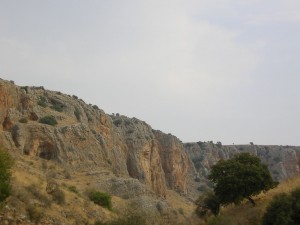
The location of the hike.
Picture: http://tiyulim.blogspot.com/2007/10/blog-post_19.html
Yesterday I opened course number 2 for the present school year, close to home, at A. I heard, ahead of time, that they had closed the enrollment (at 30) because there were too many teachers but in fact there were only 26 in the group. I was so worried that there would be a large group that I planned the session a bit differently.
My main problem in planning the opening session was that I knew that a few of the teachers had been present when I did a session for DK last year in her course at the same centre. When I stood in for her and did some introductory activities and a lecture on writing, I knew I would have a problem if the same teachers enrolled in my course. On the one hand I knew the taste of the course would encourage them to enrol but on the other hand, I wouldn’t be able to return to the introductory activities.
The group is very different to that in Z in that many of these teachers have been in contact with me in the past. At least 3 have studied in my courses on inclusion and four are from my school. At least 10 others teach at schools in which my professional learning colleagues work.
I haven’t had time to read their questionnaires yet but it will be interesting. I particularly want to read why they chose this course.
When I arrived at the centre I saw something that worried me greatly. There were teachers standing in a line and the receptionist was handing them a big folder (binder) of pages advertising courses and the teachers were choosing according to categories like “Oh, for this one I don’t need to use a computer” or “Great, this one finishes by…”. Is that how educators should be choosing their professional learning? Is that what happens when teachers are coerced into taking two 30 hr courses in a year? I want to hope that nobody chose my course for those kinds of reasons.
When we got to the stage when I asked the teachers to try out “looping” there was all over agreement and cooperation. Maybe the timer I brought did the trick? I asked them to free write on the topic of “Difficulties in Teaching Writing”, a topic they can all relate to. I put the clock on for three minutes and asked them to write quietly without stopping. Then I asked them to stop, to circle the 5 most important words they had written. I then gave them another three minutes on the clock to continue writing, this time concentrating on those five central terms. Apart from the teacher who corrected maths exams throughout the whole session (3 hours!), they were all quiet and did quite a bit of writing.
This wider participation may have been due to several reasons:
I told them that the discussion on how they felt during the writing and how they reacted to the task would be in the virtual campus so I better set up the discussion group quickly. There is no doubt that I will find the 30 hour time limit frustrating. I need to be careful that it isn’t always the collaborative work and the discussions that I skip.
This week I have my second session at Z – I had a few email responses which were very positive.
I have just finished reading one of the second hand books I bought from Better World Books.
15 minutes free writing:
I was surprised to find this book in the catalogue and even more surprised when I began reading it. This narrative was written ten years ago but very much reflects the type of work I am doing and the type of texts I am producing.
Miller Power works (worked?) with students learning to be teachers and writing teachers and taught them methodology through writing. Her course was based on the students reflecting and writing narratives and on the author responding at length to the stories which appeared in journals and assignments.
I quickly connected to Miller Power’s style and chose to read this book without pencil in hand, something I rarely do. There was something about the name of the book and the opening texts which signalled to me that this short book would be read and reread by me.
There are a variety of texts in the book, many written by students.
Some of the important messages for me at this stage are:
I promise there will be more…
Miller Power, B. (1997). Long roads, short distances: Teaching writing and writing teachers.Portsmouth, NH: Heinemann.
After the last course at N, one of the teachers tried the peer revision strategies we explored, in her grade 2 classroom. She remarked that she could never (and would never) have tried the activity with her pupils if we had not really modelled and experienced it in the course.
I was happy to receive feedback on classroom developments coming out of the course and to hear that the time we are spending in personally experiencing strategies and reflecting on them is worthwhile.
The session at K was also fruitful. After a lecture (shortish) on revision practices and teaching revision, the teachers worked in groups to write a list of specific criteria for evaluating teacher narratives. They worked well and we had the opportunity to feel the difference between specific and general criteria.
Afterwards, the teachers worked in pairs – one as a writer and the other as an editor to work on the revision of their first narratives. They stayed close to the process I suggested for use in the classroom and they worked busily for almost an hour. Now I am waiting to see the revised narratives and to read the upcoming reflective pieces on the process.