Incredible Teacher Narrative at Z

November 26, 2009

The course at Z is going extremely well. I feel as though the 26 teachers participating are involved and eager to try to change things in their writing instruction and that many are thinking about their own learning and really taking ideas and thoughts back to their classrooms.

Last week we had a virtual session and the task I gave was to write a professional narrative connected to the teaching of writing and/or writing with students. Beforehand we discussed the rational of the task and I even brought an example from last year’s group. Many of the participants in this group are not too computer confident and I was worried that they wouldn’t manage finding the virtual campus, posting their stories and responding to others. All in all my worries were unwarranted and most of the teachers wrote and posted narratives. At the moment they are reading and responding to other stories.

The night before this week’s session, I was busy collecting the stories (for future use…) and responding. I respond to each and every narrative and try to be involved in the responses too. Many of my responses at this stage are questions which will help in the revision process to come.

One story made my heart race and brought tears to my eyes. I read it again and again before I wrote a detailed response. Immediately I wrote an email to the teacher author and asked her permission to bring her narrative to the group session. She readily agreed.

O wrote that at our last session she wasn’t able to concentrate – not in my lecture, not on the PowerPoint presentation that went with it and not on the workshop we did together. She said that concentrating on the writing process wasn’t possible for her. O told that that morning she had been on a hike with her class and that at one stage an eight year old boy fell off a cliff. He was extremely lucky that he wasn’t killed and that he was only injured fairly lightly. She told of her experience, of the phone call from the principal telling her that the incident was already reported on the Internet, of the terror, the helplessness and the frustration of not being able to protect her student.

O went home after our session and didn’t sleep all night. She was terrified of walking into the classroom the next morning and facing this reality. The injured child was in hospital and she had a whole classroom of traumatized children to deal with. After hours of deliberation, O remembered what we had been talking about in the course session and decided, at 4 am when she finally got out of bed, to devote the day to writing with her pupils. She decided to spend the day writing with her students to different audiences with different goals.

Lacking confidence, O entered the classroom and after a brief discussion, explained to the pupils what they could do. Some wrote to their injured friend in hospital, some wrote to the people responsible for the hiking trail, some wrote thank you letters to the parents who helped on the hike and helped deal with the complex situation and some wrote rules for behavior on trips outside school. During the writing time, O was free to move between the pupils and talk privately to each and every one of them. She could hear how they were coping and how they were feeling.

The pupils wrote and wrote. O was surprised that even her weakest students, those that usually refrain from writing, were creating important texts. She wrote that she sensed that the act of writing was helping these children process the experience and regain confidence and control. She admitted that the classroom interactions, the writing and the activity helped her regain her self confidence as a teacher. The pupils were so involved in this process that they asked to continue the next day, they had discovered that they enjoyed writing for real purposes and for real audiences. They had experienced writing as a means of sincere self expression.

A few days later O decided to tell this story as her narrative about writing. She told her story bravely and as a result received a lot of positive and supportive feedback from the other teachers. This event has changed the way O sees writing instruction and has changed the way many of her pupils view writing tasks.

One of the questions I asked O was whether she had told her principal about the way she decided to cope in the classroom. She replied that she hadn’t . I suggested she show the principal (if not all the other staff) her narrative – they can all learn from it as we did in the group.

Since reading  O’s story she is with me all the time. I am thinking about her terrifying experience, about her coming to my course after such a traumatic event and not telling anyone and about how she used writing to help her students recover.

Apart from receiving a lot of satisfaction that the materials we discuss in the course are making a real difference in the professional lives of teachers and their pupils, I was excited to see the process of writing itself encouraging the creation of new texts. O described how the writing done by her pupils encouraged her and stimulated her to write and I told her that her narrative had stimulated me to write a narrative of my own. I have no doubt that the writing of many teachers in the course will be enriched by the sharing of O’s story.

In a reflective discussion in her classroom, O told her pupils that she too had written a story after the traumatic event. Her pupils were very curious to hear that their teacher enjoyed the benefits of  writing too.

I still have a lot of thinking to do about the links between O’s story and the learning in our course and about professional narratives being links in a chain, a chain which strengthens and supports both writers and readers.

I am waiting to read the responses on the online forum, to see O’s text revised and to see the influence of O’s story on other narratives being created by teachers in the group.

amud

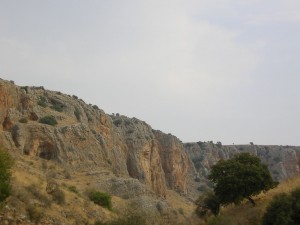
The location of the hike.

Picture: http://tiyulim.blogspot.com/2007/10/blog-post_19.html


New Course at A, New Excitement

November 8, 2009

Yesterday I opened course number 2 for the present school year, close to home, at A. I heard, ahead of time, that they had closed the enrollment (at 30) because there were too many teachers but in fact there were only 26 in the group. I was so worried that there would be a large group that I planned the session a bit differently.

My main problem in planning the opening session was that I knew that a few of the teachers had been present when I did a session for DK last year in her course at the same centre. When I stood in for her and did some introductory activities and a lecture on writing, I knew I would have a problem if the same teachers enrolled in my course. On the one hand I knew the taste of the course would encourage them to enrol but on the other hand, I wouldn’t be able to return to the introductory activities.

The group is very different to that in Z in that many of these teachers have been in contact with me in the past. At least 3 have studied in my courses on inclusion and four are from my school. At least 10 others teach at schools in which my professional learning colleagues work.

I haven’t had time to read their questionnaires yet but it will be interesting. I particularly want to read why they chose this course.

When I arrived at the centre I saw something that worried me greatly. There were teachers standing in a line and the receptionist was handing them a big folder (binder) of pages advertising courses and the teachers were choosing according to categories like “Oh, for this one I don’t need to use a computer” or “Great, this one finishes by…”. Is that how educators should be choosing their professional learning? Is that what happens when teachers are coerced into taking two 30 hr courses in a year? I want to hope that nobody chose my course for those kinds of reasons.

When we got to the stage when I asked the teachers to try out “looping” there was all over agreement and cooperation. Maybe the timer I brought did the trick? I asked them to free write on the topic of “Difficulties in Teaching Writing”, a topic they can all relate to. I put the clock on for three minutes and asked them to write quietly without stopping. Then I asked them to stop, to circle the 5 most important words they had written. I then gave them another three minutes on the clock to continue writing, this time concentrating on those five central terms. Apart from the teacher who corrected maths exams throughout the whole session (3 hours!), they were all quiet and did quite a bit of writing.

This wider participation may have been due to several reasons:

  • The teachers were trying out a strategy to be used in the classroom
  • I wrote on the program for the course that teachers would be expected to write
  • It is that kind of group…

I told them that the discussion on how they felt during the writing and how they reacted to the task would be in the virtual campus so I better set up the discussion group quickly. There is no doubt that I will find the 30 hour time limit frustrating. I need to be careful that it isn’t always the collaborative work and the discussions that I skip.

This week I have my second session at Z – I had a few email responses which were very positive.


Professional learning = Student learning? / Doecke & Parr

June 3, 2008

Today I reread the first chapter of Doecke and Parr and was surprised that the notes I had made previously didn’t make the blog or the methodology chapter.

Points I will add are:

  • Through writing teachers can explore their professional lives and “refine their understandings of the complexities of teaching and learning” (p. 9).
  • “This is obviously of benefit to the students in their classes, although those benefits do not necessarily translate into tangible outcomes that can be easily measured” (p. 9).
  • “… qualities that teachers value most in their students’ learning-intellectual curiosity, a willingness to engage in exploratory talk, imagination, a preparedness to collaborate while also accepting a degree of autonomy, a capacity to engage in metacognition and reflexivity-are the very same qualities that characterize their own professional learning. Teachers who engage in practitioner inquiry are much more likely to be able to generate a ‘culture of inquiry’ in their own classrooms” (Reid 2004, p. 12 as cited here p. 12).
  •  writing 3 fold: writing as artefact, writing as process, writing as medium – see p. 13. I can link the writing in my thesis to these concepts.


Doecke, B., & Parr, G. (2005). Writing: A common project. In B. Doecke, & G. Parr (Eds.), Writing = Learning (pp. 1-16). South Australia: Wakefield Press.


An (old) Australian contribution to the debate

May 28, 2008

I just realized that I haven’t used this article, one of the first I found when I started getting into the teacher-writer question.

The authors did a study of 7 Australian secondary teachers, “four of whom write with their students and three of whom don’t. The aim was to see if there were differences in the way they teach writing.

The authors define teacher writers as teachers who write outside of school hours, regardless of the purpose or the audience of the writing done.

Assumptions formulated by the authors before the study were:

  1. Teacher -writers possess a “stronger knowledge base “than non writers
  2. Teachers who write are better able to understand difficulties faced by pupils and respond from personal experience
  3. Teacher-writers can better motivate students to write as a result of their own passion for writing

All teachers in the study were known as successful writing teachers.

Study:

  • teachers observed teaching
  • 2 interviews
  • questionnaire on beliefs and practice

The study only researched the teaching of personal and imaginative writing.

The 4 teacher-writers held different views on the influence of their own writing experience on their teaching.

No clear correlation between the degree of teacher intervention with individual students, the stages in the writing process at which teachers intervened, and the writing background of the teachers”

“…no clear pattern” in the amount of explicit instruction

There were marked differences in the field of feedback to students but theses did not reflect the writer/non-writer background of the teachers.

Not one of the participating teachers believed that teacher writing improves writing instruction.

Ros one of the participating teachers argued:

“Teachers who were highly attached to their identity as writers might be too prone to have fairly narrow, self-confirming notions of good writing in ways that might be counter-productive for some students” (p. 47).

Small sample

No clear findings in practice which separate teacher writers from non-writers.

“All participant teachers perceived writing oneself and teaching writing as quite separate skills demanding quite different techniques” (p. 48).

Teacher writing is one way of acquiring a knowledge base for the teaching of writing. It may help to understand the task of writing but teachers need far wider knowledge than that.

“No necessary link between becoming a writer and teaching writing better” (p. 48).


Gleeson, A., & Prain, V. (1996). Should teachers of writing write themselves?: An Australian contribution to the debate. The English Journal, 85(6), 42-49. Retrieved from http://www.jstor.org


Getting Teachers to Write – narrative draft

May 14, 2008

notebook_sized.jpg 

While writing this thesis I was running a professional development program for teachers of grades two to six. The name of the twenty eight hour course was “Improving Literacy in a Heterogeneous Class”. The teachers voluntarily signed up.  I began the course by asking the fourteen teachers participating to fill in a questionnaire about themselves, their teaching experience and their expectations of the course. I included a list of possible topics and asked them to mark those most relevant and important to them. I was not surprised to find that the most pressing topic for all of the participants was the teaching of writing and supporting struggling writers.  I opened the third meeting by asking the teachers to write for ten minutes in silence, the topic being an experience they have had teaching writing. I told them that we would be discussing those pieces after the writing period was over.  One teacher immediately left the room, a toilet or coffee break I assumed. Another took out her cell phone and began clicking furiously. Others doodled quietly in their notebooks, began listing points or began to fill lines with Hebrew script.  I sat and watched them, uncomfortable with the squirming that was going on in several of the seats. Each minute that went past was like five, my watch didn’t seem to move. I forced myself to wait ten minutes, resisting my urge to cut the time down to seven or eight minutes.  Silence was kept in the room for most of the time, although occasionally there were embarrassed giggles or a whisper.  When the time was up, some of the teachers were still busily writing their narratives and were sorry to stop. Others looked relieved and were waiting to get on with the seminar.  In the discussion that followed I was interested in hearing what had happened to the participants in those ten minutes, what they had felt and what they had experienced and done in that time.  Many of the teachers commented that they are unused to writing on demand and that they felt uncomfortable. Some confessed that they are not used to writing at all. Several remarked that the time limit and the expectation of sharing their writing pressured them. At least two of the teachers didn’t write at all in the ten minute period. Only two or three confided that they enjoyed the writing experience.  We looked in detail at what had been done in that time and saw how the writing process is different for different people. Afterwards we discussed the implications for these differences in our classrooms. One of the teachers who didn’t write anything, an experienced grade six teacher, explained to the group that she isn’t a writer. “People are either born writers or they aren’t, I’m not” she said. The group discussed this statement. Is it true? If it is, what does it mean for the teaching of writing? I added that this is one of the major misconceptions held by struggling writers in our classes.  I asked the teachers if anyone was willing to share their text with us. Two of the first volunteers started to tell their story without looking at the page. I stopped them and reassured them that it is clear to everyone that this is the roughest of rough draft but that we want to hear what is on the paper.  Two of the pieces we heard were well structured, interesting stories. We were amazed by the writers’ style and clarity. At the end of the session I explained that our next meeting would not be face to face, that we would be meeting on the virtual campus. Each teacher was required to do three things, firstly to revise her story about the teaching of writing (or write another story) and to post it on the assigned private discussion board. The second task was to reflect on the teaching story and on the experience of writing one, I supplied possible directions for this. The third task was to read stories from other group members and respond.  It took ages and lots of encouragement for the first teacher to post a story. She wrote about a poetry anthology she had successfully produced at her school. The poems were all connected to Israel’s sixtieth birthday. This teacher told how she had created a poetry unit suitable for each different age group, chosen appropriate poetry to teach, and encouraged the children to write. Every child in the school had writing published in the festive booklet. She told her story modestly but proudly and expressed her personal excitement and satisfaction with the project. A few days after this story appeared, comments began to appear, most of them congratulating the teacher on her success in the project but also on being the first to contribute a story. Questions also appeared. Gradually a few other stories appeared on the site and the discussion was lively.  Unfortunately only five of the participants took part in the discussion. At our next meeting, I devoted time to the oral reading of those stories posted on the campus and gave those teachers time to share their experiences with the group. I was sure that my enthusiasm, together with showing the participants that it is possible to complete the task, would motivate the others to write and share their stories. A few weeks later, I am still waiting… Although I know that time is a central factor in any work I do with teachers, here I know that the type of task assigned was significant in the low rate of participation.  I am continually aware that these teachers have not been asked to write anything of this nature for a very long time, some of them since they were at school. Another factor is that in a twenty eight hour course many of the teachers do not know each other and may feel vulnerable as a result.  I have tasted this kind of work with teachers and find it far more meaningful than choosing a topic, planning a lecture or a workshop, giving them my knowledge or experience and going home.  When I read the stories written, I was greatly aware of what I have been learning, that every teacher has something to say, that each teacher possesses professional knowledge which can be a wonderful starting point for collaborative learning. S, a second year teacher, had been very quiet and reserved in the first two sessions. We discussed writing in the third meeting and I brought examples of authors talking about the writing process and about how laborious composition is. Suddenly, S shyly told the group that she keeps a personal diary and that because she lives alone she comes home and pours her day into writing. She confessed that writing is an important part of her day. The narrative S wrote and posted was written in very simple language but told a very powerful story of her battle to get her second grade pupils to write. She told us how she used to spend each Sunday morning hearing stories from her class about what they had done on the weekend. She was frustrated that it was always the same children who related experiences and that many remained silent. She told that it was difficult for many to choose just one experience to share.  One day, S gave her pupils special notebooks and told them that they were going to write what they wanted to share from their weekend and that afterwards those that want to can tell their story. She was shocked by the result. Firstly, everybody wrote, including those who usually don’t share and her struggling writers. Secondly, many more children were willing to tell their stories. S, excited by this lesson, decided to continue.  In the weeks that followed, S asked her pupils to write every Sunday morning and was happy that the children wrote willingly and that the texts produced were more and more complex. More and more pupils asked to share their work. As a result of the reflection S did when writing her narrative for our group, she started asking the class to write on other occasions, after recess for example. Another addition was that she herself started writing while her class was busy with their heads down. She used the time for reflective writing on teaching issues. In the weeks that followed, writing became an accepted mode of communication in S’s class. When children were involved in an argument or had a problem, she asked them to first organize their thoughts by writing them in the notebook and that afterwards she would be happy to listen to them. It worked. When S got to school after her day off, she would find a pile of notes waiting for her on her desk. Subject teachers who taught the class were surprised when they began to receive written communication from the young children.  S received positive feedback on her work from the members of our group and also heard ideas for continuing and expanding her work. I found it very satisfying that through this activity she realized that she has something significant to share with a group of experienced teachers. Many of the veteran teachers certainly had something to learn from this shy and nervous early career teacher. I realized that S was similar to her shyer pupils, those that only dared to share a story when they had it firmly on paper.  There is no tradition of composing teacher narratives and collaborating on them in this part of Israel. There are presently no formal options for professional learning through dialogic writing and discussion. Despite the fact that this small scale experience was only partly successful, I am optimistic that significant learning frameworks can be established for Israeli teachers in this direction.  In order to succeed, I believe teachers need to know ahead of time that this will be the framework of the seminar and that they know they will be committed to experience the writing and discussing of teacher narratives. A mix of experienced and early career teachers is likely to be preferable – building on the enthusiasm and burning need for collaboration amongst newer teachers and the experience and knowledge of veteran educators.  I have already taken the first few steps. I have surprisingly managed to convince the coordinator of language and literacy in the northern area of Israel, that this is the way we should be going in our PD for next year. Most of the courses we will be offering will deal with the teaching of writing and they will all be structured around teacher collaboration and the writing and sharing of narratives.  If we begin with a respect for the knowledge the teachers bring with them and their honest desire to raise the achievement levels of their pupils in writing, I hope they will sign up and then be open, flexible and active participants.


Examples of teacher writing didn’t work / Adam

May 12, 2008

In an attempt to engage her students in writing, Adam tried bringing her own experience in personal writing into the classroom – with no success.

“I tried to conjure up some samples of my own personal writing. I shared these with my classes, but the samples didn’t solve my problem. Students pointed out that I was older, and of course writing was easier for me” (p. 30).

Adam, D. J. (1992). Journal literature and writing: A fusion. The English Journal, 81(6), 30-32. Retrieved from http://www.jstor.org