One of the books GP introduced me to while I was in Melbourne was:
Private readings in public : schooling the literary imagination by Dennis Sumara.
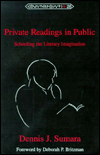
I want to start with some short quotes in which Sumara describes the research process. I found this first chapter of the book very reassuring – I will attempt to explore the reasons why.
“This is also what it means to include research into one’s life. Like the reading of literary fictions, inquiry into lived experiences means deciding that the research will not simply be reduced to a series of “data gathering” tasks. Rather, it means that the researcher will dedicate her or his life to “learning to see” differently… the researcher must live a life that allows for this shift in perception, a life that includes a particular “focal practice”… (p. 9).
I believe that my decision to continue on with my study journey, beyond my Masters degree is strongly connected to this change in focus described by Sumara. I have honestly begun to learn to see the world in general and my work as an educator, in particular, differently. I admit that this learning will probably be life long and that reflection and inquiry will be be developed slowly over time. I feel that every professional conversation, every text read and every new project which arises is somehow new material to be explored.
“During the course of my investigations into the schooling of shared reading there were many times when I felt a bit lost, unsure, confused and wished for the “good old” pre-determined research plan. In retrospect, I am pleased that I chose to put up with the ambiguity of it all, for although many deliberate decicisions were made that changed the course of the research path, as many unanticipated things occured that dramatically altered the course of my own understanding” (p. 11-12).
Each time I read another researcher openly admitting to the insecurities encounted on the road to success, I am relieved and grateful for their honesty. I imagine that my path will be crowded with questions, problems, dilemmas, dissatisfaction and doubt. The more I am convinced that this is natural and normal, the easier it will be to cope.
When I finished my Masters thesis and reflected on the process, I, like Sumara, was “pleased that I chose to put up with the ambiguity of it all”. I would never have reached my goal without it. Even now, I have no idea how the parts of the puzzle fit together, it certainly wasn’t planned ahead.
“I describe my inquiries as “post modern” because I am not claiming (or aiming) to present a unified, fixed or complete theory of reading or of shared reading in schools. I acknowledge that my inquiries evolved from a particular set of historical, cultural, and political situations that shaped not only my research method but my interpretations of the data that was gathered and the life that I lived around those inquiries and interpretations” (p. 12).
This quotation is brilliant and it seems I should read it aloud to myself at each intersection in my work. One of my goals is to look at how my interpretations are developing and how my life experience and my particular cultural context are influencing my work.
“There is a deep understanding that there is no word, no phrase, no theory, no narrative, that can ever capture the fullness of human thought and experience” (p. 14).
Another sentence that should be hung up above the desk. Experience and narrative are not the same thing. I should be exploring the relationship between them more.



